
How AI Chatbots Help Small Businesses Improve Customer Service
AI chatbots with RAG technology help small businesses deliver 24/7 customer service, answer routine questions, capture leads, and reduce repetitive staff workload. By retrieving information from business-specific knowledge bases, they provide more relevant responses across websites, Facebook Messenger, Zalo, and WhatsApp. Hybrid search, reranking, integrations, and human escalation further improve accuracy and customer experience.

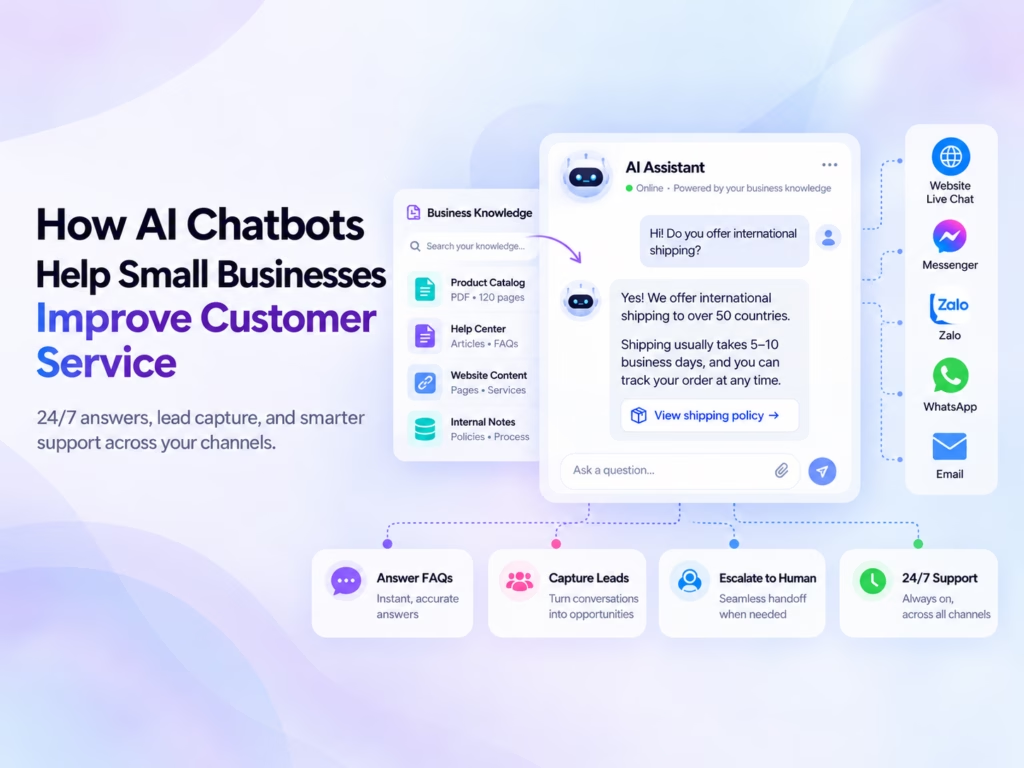
How AI Chatbots Help Small Businesses Improve Customer Service
Customers increasingly expect quick answers, convenient communication, and support outside normal business hours.
For a small business, meeting those expectations can be difficult. Staff may already be busy serving customers, handling bookings, managing sales, and running day-to-day operations. Answering the same questions repeatedly through a website, Facebook Messenger, Zalo, WhatsApp, or email adds another layer of work.
An AI customer-service chatbot can help by handling common questions, capturing leads, guiding customers toward the right service, and escalating conversations when human assistance is needed.
Modern chatbots can also use Retrieval-Augmented Generation (RAG) to answer questions using a business’s own information rather than relying only on the AI model’s general knowledge.
For small and medium-sized businesses, this makes AI customer service far more practical than earlier generations of simple scripted chatbots.
Key Takeaways
- 24/7 availability: AI chatbots can answer common questions and capture leads outside normal business hours.
- Less repetitive work: Routine questions can be handled automatically, allowing staff to focus on customers and tasks that require human judgment.
- RAG improves accuracy: A RAG chatbot retrieves relevant information from the business’s own knowledge base before generating an answer.
- The chatbot can reflect your business: You can customize its tone, instructions, knowledge, lead flow, and escalation rules.
- Chatbots can work across multiple channels: A single AI system can support conversations on a website, Facebook Messenger, Zalo, WhatsApp, and other channels.
- Better retrieval matters: At UNLOQ AI, we use hybrid search and reranking in our RAG architecture to improve the relevance of the information given to the language model.
Why AI Chatbots Are Useful for Small Businesses
For many small businesses, customer communication is highly repetitive.
Customers frequently ask questions such as:
- What are your opening hours?
- How much does this service cost?
- Do you have availability?
- What is included in this package?
- What is your cancellation policy?
- How do I book?
- Can someone contact me?
These are important questions, but answering them manually again and again consumes staff time.
An AI chatbot can act as the first point of contact. It can answer routine questions immediately and collect information when a customer is interested in a product or service.
The goal is not to replace every human interaction.
A well-designed chatbot handles the predictable conversations and passes complex, sensitive, or high-value interactions to staff when appropriate.
24/7 Customer Support and Lead Capture
Customers do not always contact a business during office hours.
Someone may research a hotel late at night, ask an education center about courses on a Sunday, or enquire about a travel package after the sales team has gone home.
Without an immediate response, the business may not hear from that customer again.
A chatbot can respond immediately, provide relevant information, and collect useful lead details such as:
- name;
- phone number;
- email;
- required service;
- travel destination;
- preferred course;
- budget;
- booking date.
Staff can then follow up on the lead.
This is one of the most useful applications of AI chatbots for SMBs: they allow the business to continue engaging potential customers even when no employee is available.
Reducing Repetitive Customer-Service Work
AI chatbots are particularly effective at handling high-volume, predictable conversations.
A spa might repeatedly receive questions about treatment types and opening hours.
A hotel may be asked about check-in times, breakfast, airport transfers, and room facilities.
An education center may receive dozens of questions about course levels, schedules, tuition, trial lessons, and placement tests.
A travel agency may repeatedly explain destinations, tour durations, departure locations, and package inclusions.
Automating these conversations can reduce the amount of time staff spend answering basic questions.
Employees can then focus on situations where human involvement adds more value, such as complex sales discussions, complaints, customized recommendations, or unusual requests.
AI Chatbots Can Do More Than Answer FAQs
A modern chatbot does not have to function as a static FAQ system.
Depending on the business and its existing software, it can also connect to external systems and workflows.
For example, a chatbot may be able to:
- collect and qualify leads;
- send customer information to a CRM;
- trigger email or SMS notifications;
- check information from a database;
- guide customers toward a booking system;
- create internal notifications for staff;
- hand conversations over to a human;
- update spreadsheets or business applications.
This is where AI chatbots become more useful than simple website chat widgets.
The conversation can become part of a wider business workflow.
Why RAG Matters for Customer-Service Chatbots
One of the biggest limitations of a general-purpose AI model is that it does not automatically know the details of your business.
It may understand what a hotel, language school, travel agency, or retailer does in general, but it does not inherently know:
- your current prices;
- your products;
- your policies;
- your schedules;
- your promotions;
- your service details;
- your internal procedures.
Retrieval-Augmented Generation, or RAG, addresses this problem.
Instead of asking the language model to answer entirely from its training data, a RAG system first retrieves information from a business-specific knowledge base.
That information can come from sources such as:
- website pages;
- PDFs;
- FAQs;
- service catalogs;
- spreadsheets;
- policy documents;
- internal documentation;
- product information.
The relevant information is then passed to the language model together with the customer’s question.
The LLM uses that context to formulate its response.
A Simple Way to Understand RAG
RAG can be thought of as giving the AI access to an open book before it answers.
Without RAG, the language model is primarily relying on what it learned during training and whatever information is included directly in the current conversation.
With RAG, the chatbot can first search the business’s own information.
If a customer asks:
“Does the Deluxe package include interior cleaning?”
the system can retrieve the section of the company’s service information describing the Deluxe package and use that information to answer.
Likewise, if someone asks:
“What time can I check in?”
a hotel chatbot can retrieve the actual check-in policy rather than relying on general assumptions about hotels.
This makes the chatbot significantly more useful for business-specific questions.
RAG Reduces the Risk of Incorrect Answers
Large language models can generate convincing answers even when they do not have the correct information.
This is commonly referred to as hallucination.
RAG helps reduce this risk by giving the model relevant source material before it answers.
However, RAG does not eliminate hallucinations completely.
The quality of the final response still depends on several factors:
- whether the correct information exists in the knowledge base;
- whether the retrieval system finds it;
- whether the retrieved information is current;
- whether the language model interprets it correctly;
- how the chatbot is instructed to respond when information is missing.
This is why the quality of the retrieval pipeline matters just as much as the language model itself.
Why Retrieval Quality Matters
A basic RAG chatbot often uses semantic vector search to find relevant information.
Vector search is good at understanding meaning.
For example, it can recognize that:
“Can I change my booking?”
is related to a document titled:
“Reservation modification policy.”
But vector search alone can sometimes miss exact terms such as:
- product codes;
- course names;
- model numbers;
- policy numbers;
- error codes;
- names and acronyms.
Keyword search has the opposite strength: it is very good at exact matches but less capable of understanding alternative phrasing.
That is why UNLOQ AI uses hybrid search, combining keyword and semantic retrieval.
This provides a stronger pool of candidate information than relying on either method alone.
Why UNLOQ AI Also Uses Reranking
Hybrid search retrieves potentially relevant information, but not every retrieved passage is equally useful.
A second step called reranking can evaluate those candidate passages more closely against the customer’s complete question.
A simplified retrieval pipeline looks like this:
Customer question → Keyword search + Vector search → Hybrid ranking → Reranking → Best context → LLM response
Hybrid search helps find a broad set of relevant information.
Reranking then helps identify which passages are most likely to answer the question accurately.
At UNLOQ AI, we use both techniques to improve the quality of the context provided to the language model.
The aim is simple: retrieve the most relevant information possible before asking the AI to respond.
Training the Chatbot on Your Business Information
A useful business chatbot needs access to reliable source material.
Depending on the business, this may include:
- website content;
- product catalogs;
- course information;
- service descriptions;
- pricing documents;
- policy PDFs;
- internal FAQs;
- spreadsheets;
- booking procedures.
The information is processed and indexed into a searchable knowledge base.
When the underlying business information changes, the knowledge base can also be updated.
This is important because a customer-service chatbot should reflect the business as it operates today—not information that was true several years ago when an LLM was trained.
Customizing the Chatbot to Your Brand
Accuracy is only one part of customer experience.
The chatbot also needs to communicate in a way that fits the business.
A hotel may want a polite, professional concierge-style assistant.
A language center may prefer a friendly admissions assistant.
A premium service business might want concise, formal responses.
The chatbot can also be configured with rules governing:
- tone of voice;
- greetings;
- terminology;
- forms of address;
- how many questions to ask at once;
- when to collect lead information;
- when to recommend a service;
- when to escalate to staff;
- topics the chatbot should not answer.
This makes the chatbot feel less like a generic AI interface and more like part of the company’s customer-service operation.
Supporting Customers Across Multiple Channels
Customers do not interact with businesses through a single channel.
Some prefer the company website.
Others use Facebook Messenger, Zalo, or WhatsApp.
Rather than maintaining a separate chatbot logic for every platform, the same underlying AI agent can be connected to multiple communication channels.
For example, UNLOQ AI chatbots can be deployed across channels such as:
- website live chat;
- Facebook Messenger;
- Zalo OA;
- WhatsApp.
The same knowledge base and business rules can then be applied across those channels.
This provides customers with a more consistent experience and makes the system easier for the business to maintain.
Practical Examples
Education Centers
An AI chatbot can answer questions about:
- course levels;
- schedules;
- tuition;
- placement tests;
- trial classes;
- admissions procedures.
It can also collect a student’s name, phone number, age, learning goals, and current level before passing the lead to an admissions consultant.
Travel Agencies
A travel chatbot can answer questions about destinations, tour schedules, pricing, inclusions, and departure locations.
It can also collect travel dates, group size, destination preferences, and budget before sending the lead to a travel consultant.
Hotels
A hotel chatbot can answer common questions about:
- check-in and check-out;
- room facilities;
- breakfast;
- airport transfers;
- hotel policies;
- nearby attractions.
More complex booking questions can be passed to staff or connected to an appropriate reservation workflow.
Retail and Service Businesses
A chatbot can help customers compare products or service packages, explain policies, answer availability questions, and direct high-intent customers toward a purchase or booking.
Where Human Support Still Matters
Not every conversation should be automated.
There are situations where the chatbot should deliberately hand the conversation to a person.
These may include:
- complaints;
- disputes;
- refunds;
- unusual requests;
- sensitive customer information;
- complex sales negotiations;
- questions where the knowledge base does not contain a reliable answer.
A good AI customer-service system therefore needs both automation and escalation.
The chatbot handles conversations it can answer confidently and helps staff identify the interactions that need human attention.
UNLOQ AI’s Approach
At UNLOQ AI, we build customer-service chatbots around the business’s own information and workflows.
Our approach typically combines:
Business knowledge → Hybrid retrieval → Reranking → LLM response → Business workflow or human handoff
This allows the chatbot to do more than generate conversational responses.
It can use business-specific information, capture leads, connect to other systems, work across multiple communication channels, and transfer conversations when human assistance is required.
For Vietnamese businesses, we can also design the retrieval and language-model stack around strong Vietnamese support rather than forcing customer conversations through an English-first workflow.
The result is a chatbot designed around how the business actually operates and how its customers actually communicate.
Conclusion
AI chatbots can give small businesses a practical way to improve customer service without requiring staff to answer every repetitive question manually.
They can provide immediate responses, capture leads outside office hours, automate routine conversations, and connect customer interactions with other business processes.
RAG makes these systems significantly more useful by grounding responses in the company’s own information.
But simply adding RAG is not enough.
The quality of the knowledge base, retrieval system, language model, business rules, integrations, and human-handoff process all contribute to the final customer experience.
At UNLOQ AI, we combine RAG, hybrid search, and reranking to give the chatbot highly relevant business context before it generates an answer.
For SMBs, the objective is not to replace human customer service. It is to automate the conversations that can be handled reliably so staff can spend more time on the ones that genuinely need them.
Frequently Asked Questions
What is an AI customer-service chatbot?
An AI customer-service chatbot is software that uses a language model to communicate with customers through natural conversation. It can answer questions, collect information, guide users toward services, and connect with business systems or human staff.
What is RAG?
RAG stands for Retrieval-Augmented Generation. It allows a chatbot to search a business-specific knowledge base before answering a question. Relevant information is retrieved and provided to the language model as context for its response.
Does RAG prevent AI hallucinations?
RAG can significantly reduce hallucinations caused by missing information, but it does not eliminate them completely. Retrieval quality, source accuracy, model behavior, and chatbot instructions all affect the reliability of the final answer.
What is the difference between hybrid search and reranking?
Hybrid search combines different retrieval methods, typically keyword and semantic vector search, to find candidate information. Reranking then evaluates those candidates more closely and prioritizes the passages most relevant to the customer’s question.
Can an AI chatbot capture leads?
Yes. A chatbot can collect information such as a customer’s name, phone number, requirements, budget, or preferred service and send that information to a CRM, spreadsheet, messaging system, or staff member.
Can a chatbot connect to Facebook Messenger, WhatsApp, and Zalo?
Yes. The same underlying AI chatbot can be connected to multiple supported communication channels, including website chat, Facebook Messenger, WhatsApp, and Zalo OA, allowing the business to use a consistent knowledge base and customer-service workflow.
Can an AI chatbot handle bookings?
It depends on the booking or reservation system being used and the integrations it supports. A chatbot can often guide customers to a booking flow, collect booking information, or interact with an external reservation system when a suitable integration is available.
Is an AI chatbot suitable for small businesses?
It can be particularly useful for businesses that receive a significant number of repetitive enquiries, need to capture leads outside office hours, or want to provide consistent customer service across several channels. The value depends on the volume and type of conversations the business handles.