
How Hybrid Search Improves RAG Chatbot Accuracy
Retrieval-Augmented Generation (RAG) chatbots depend on retrieving the right context before generating answers. While semantic vector search understands meaning, keyword search reliably captures exact product codes and technical terms. Combining both through hybrid search and adding a reranking layer gives your AI chatbot the most accurate context, dramatically improving response quality and customer service performance.

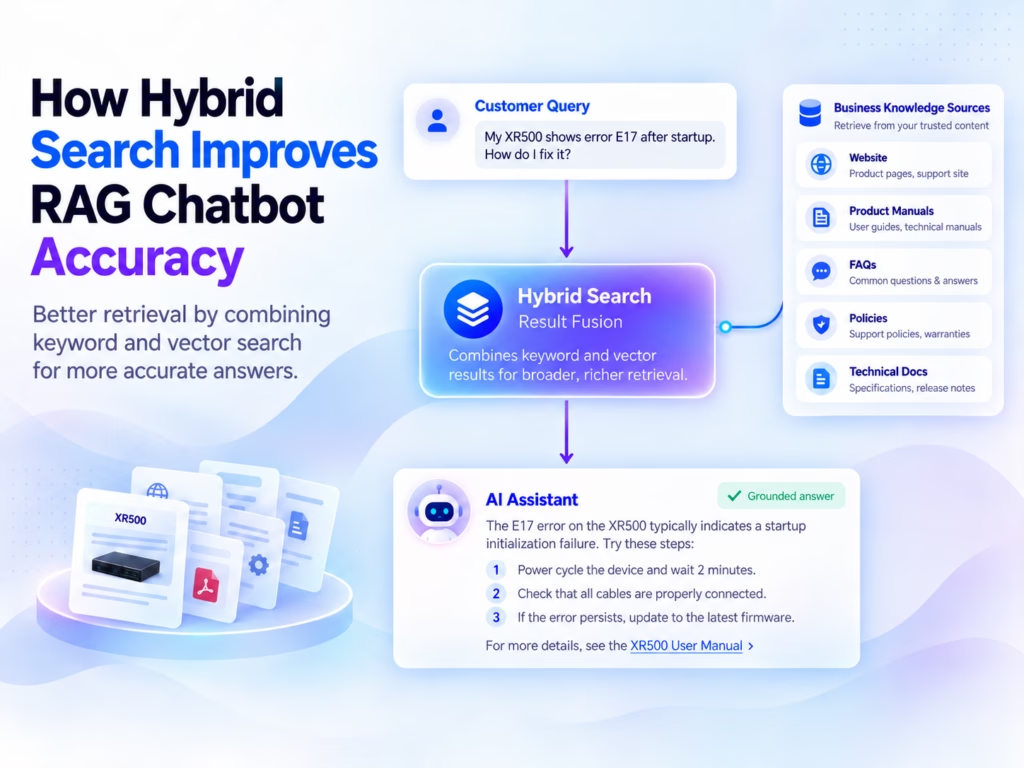
A RAG chatbot can only give a good answer if it retrieves the right information first.
Semantic vector search is good at understanding meaning, but it can miss exact terms such as product codes, error messages, model numbers, policy names, or technical terminology. Keyword search has the opposite strength: it finds exact words reliably but can struggle when customers phrase questions differently from the source material.
Hybrid search combines both approaches. By using keyword and semantic search together—and then reranking the strongest candidates—a RAG chatbot can retrieve more relevant information before the language model generates its answer.
For customer service, that can make a significant difference, especially when a knowledge base contains a mixture of natural-language FAQs, policies, product names, abbreviations, technical terms, and structured identifiers.
Key Takeaways
- RAG depends on retrieval quality: The language model can only work with the information retrieved from the knowledge base.
- Vector search understands meaning: It is useful when customers describe something differently from the way it appears in your documentation.
- Keyword search catches exact terms: It is especially useful for product names, model numbers, error codes, policy names, acronyms, and technical terminology.
- Hybrid search combines both: Using lexical and semantic retrieval together improves the chances of finding the right information.
- Reranking adds another accuracy layer: After retrieval, a reranker can reassess the candidate results and prioritize the passages most relevant to the customer’s actual question.
- UNLOQ AI uses both hybrid search and reranking: This gives our RAG chatbots a stronger retrieval pipeline before any information is passed to the LLM.
Why Retrieval Matters in RAG Chatbots
Retrieval-Augmented Generation, or RAG, connects a language model to a controlled knowledge base.
When a customer asks a question, the system searches relevant company information such as FAQs, policies, product documentation, manuals, website content, or internal knowledge. The most relevant passages are then passed to the LLM, which uses them as context when generating the answer.
This gives businesses a practical way to build AI assistants that can answer questions using current, company-specific information rather than relying only on the model’s general training data.
But RAG introduces an important dependency: the answer is only as good as the information retrieved.
If the retrieval system returns the wrong documents, misses an important policy, or fails to find an exact product reference, the LLM receives incomplete or irrelevant context.
Improving retrieval is therefore one of the most effective ways to improve a RAG chatbot.
Why Vector Search Alone Is Not Always Enough
Many RAG systems rely primarily on semantic, or vector, search.
Vector search converts both documents and user queries into numerical representations called embeddings. These embeddings capture semantic meaning, allowing the system to find information that is conceptually related even when the exact wording differs.
For example, a customer might ask:
“Why can’t I sign in?”
while the knowledge base contains:
“Troubleshooting account authentication failures.”
A good semantic search system can recognize that these passages refer to the same underlying issue even though the words are different.
This is one of vector search’s biggest strengths.
However, semantic similarity is not always enough.
Consider queries containing:
Error 404SKU-14822Model XR500Order #12345Policy HR-17- a specific product or brand name
These terms may be more effectively retrieved through exact or near-exact matching than through semantic similarity alone.
Vector search can also occasionally rank content that is conceptually similar but not actually relevant enough to answer the question.
That is where keyword search becomes valuable.
The Role of Keyword Search
Keyword search, often implemented using a sparse retrieval method such as BM25, ranks documents based on the words and phrases they contain.
Its strength is precision.
If a customer asks about:
“Error Code 404”
keyword search can strongly prioritize documents containing that exact error code.
This makes it particularly useful for:
- product names;
- model numbers;
- SKUs;
- error codes;
- policy names;
- technical terminology;
- acronyms;
- names and proper nouns.
Its limitation is that it does not understand meaning in the same way vector search does.
A customer may ask:
“How do I stop my subscription?”
while the documentation uses:
“Account cancellation procedure.”
A strict keyword search may not rank that document highly because the wording differs.
Semantic search can.
This is why the two methods complement each other.
How Hybrid Search Works
Hybrid search combines keyword retrieval with semantic vector retrieval.
Rather than forcing the system to choose one method, the same user query can be searched using both.
Each retrieval method produces its own ranked list of potentially relevant passages. The results can then be merged using a ranking method such as Reciprocal Rank Fusion (RRF), which rewards documents that perform well across the different retrieval systems.
For example, a customer might ask:
“My XR500 shows error E17 after startup. How do I fix it?”
Keyword search can strongly identify documents containing:
XR500E17
while semantic search can identify passages discussing:
- startup failures;
- initialization problems;
- troubleshooting procedures.
Combining both gives the system a broader and more reliable candidate set than either method alone.
Why Reranking Improves Retrieval Further
Hybrid search improves the pool of retrieved documents, but retrieval is not necessarily the final step.
The system may still return several passages that appear relevant based on keywords or vector similarity but differ substantially in how well they answer the actual question.
A reranker provides an additional filtering stage.
Instead of comparing the query and documents mainly through keyword statistics or embedding similarity, a reranking model evaluates the query against each retrieved passage more directly.
It then assigns a new relevance ranking.
A typical pipeline can therefore look like this:
Customer query → Keyword search + Vector search → Result fusion → Reranking → Best context → LLM response
This gives the system multiple opportunities to eliminate irrelevant information before the final answer is generated.
At UNLOQ AI, we use both hybrid search and reranking in our RAG chatbot architecture. Hybrid search gives us broad, complementary retrieval, while reranking helps identify the passages that most directly answer the customer’s question.
The objective is simple: give the LLM the most relevant possible context before asking it to produce an answer.
Hybrid Search in Customer Service
Customer-service queries are rarely written like search queries.
Customers use incomplete sentences, informal language, abbreviations, product names, copied error messages, and descriptions that may differ significantly from the terminology used in company documentation.
A customer might write:
“My order is late and tracking keeps giving me error 404. Can I get a refund?”
This single message contains several retrieval targets:
- an order or tracking issue;
- a specific error code;
- delayed delivery;
- refund eligibility.
Keyword search can help identify the exact error code and specific terminology.
Semantic search can identify information relating to delayed delivery and refund requests even if those exact words do not appear in the source material.
Reranking can then prioritize the passages most useful for answering the combined question.
This is where hybrid retrieval becomes particularly useful: not because every query requires both search methods, but because real customer conversations contain a mixture of exact and conceptual information.
Better Retrieval Means Better Context
The purpose of hybrid search is not simply to return more results.
It is to return better candidates.
A RAG chatbot typically passes only a limited amount of retrieved information to the LLM. If irrelevant passages occupy that context window, useful information can be pushed out or diluted.
A stronger retrieval pipeline helps ensure that the context contains the information needed to answer the question.
This can improve:
- factual relevance;
- handling of exact product or policy references;
- consistency;
- answers to differently phrased questions;
- handling of complex queries;
- confidence in when the system has enough information to answer.
It can also reduce one important source of hallucination: situations where the model is asked to answer using incomplete or irrelevant retrieved evidence.
Hybrid search and reranking do not eliminate hallucinations entirely. The LLM can still misunderstand or incorrectly use retrieved information. But improving retrieval significantly strengthens the foundation on which the answer is generated.
When Hybrid Search Is Most Useful
Not every RAG system requires the same retrieval architecture.
A small knowledge base with highly consistent language may work well with vector search alone.
Hybrid search becomes especially useful when the knowledge base contains a mixture of:
- FAQs;
- technical documentation;
- policies;
- product catalogs;
- error codes;
- model numbers;
- industry terminology;
- names and abbreviations;
- natural-language support content.
The more varied the information and the ways customers may ask about it, the more useful complementary retrieval methods can become.
Customer service is a particularly strong use case because customers rarely know—or use—the exact terminology found in company documentation.
Building a Strong Hybrid RAG Pipeline
Adding keyword search to vector search does not automatically create a high-quality chatbot.
Several parts of the retrieval pipeline still need to work well.
Knowledge Base Quality
The source material must be accurate, current, and clearly structured.
No retrieval system can compensate for outdated or contradictory information.
Chunking
Documents need to be divided into useful sections.
Chunks that are too large may contain too much unrelated information. Chunks that are too small may lose important context.
Embedding Model
The embedding model should perform well on the language, terminology, and content used by the business.
This is especially important for businesses using Vietnamese or other languages alongside English.
Keyword Retrieval
Sparse retrieval should be configured so that important exact terms receive appropriate weight without overwhelming useful semantic matches.
Fusion
Results from keyword and vector retrieval must be combined sensibly.
Reciprocal Rank Fusion is one commonly used approach because it can merge ranked results without requiring the raw scores from different retrieval methods to be directly comparable.
Reranking
A reranker can take the strongest candidates from hybrid retrieval and evaluate which passages are actually most relevant to the complete customer question.
This is an important part of the UNLOQ AI retrieval pipeline because it provides another level of relevance filtering before the LLM receives the context.
Measuring Whether Hybrid Search Actually Helps
The effectiveness of a retrieval system should be measured rather than assumed.
A useful evaluation begins with a representative set of real customer questions and the documents or passages that should ideally be retrieved for each one.
You can then compare different retrieval approaches, such as:
- vector search alone;
- keyword search alone;
- hybrid search;
- hybrid search with reranking.
Useful retrieval metrics can include whether the correct information appears within the top retrieved results and how highly it is ranked.
You should also evaluate the final chatbot answers for:
- factual accuracy;
- relevance;
- completeness;
- unsupported claims;
- fallback frequency;
- escalation frequency.
Customer-service metrics such as resolution rate, deflection rate, and CSAT can provide additional business-level evidence, although they are influenced by many factors beyond retrieval alone.
The important point is that hybrid search should be validated against your actual knowledge base and actual customer queries.
UNLOQ AI’s Approach
At UNLOQ AI, we do not rely on a single retrieval method for demanding customer-service applications.
Our RAG architecture combines:
Keyword search → Semantic vector search → Hybrid result fusion → Reranking → LLM generation
This gives the chatbot several layers of relevance filtering.
Keyword search helps capture exact terminology.
Vector search understands meaning and alternative phrasing.
Hybrid ranking combines the strengths of both.
Reranking then evaluates the strongest candidates again to determine which passages are most relevant to the customer’s actual question.
Only after this process is the selected context passed to the LLM.
This architecture is designed to maximize retrieval accuracy while keeping the chatbot grounded in the business’s own information.
Conclusion
RAG chatbots depend on one critical capability: finding the right information before generating an answer.
Vector search is excellent at understanding meaning, but it does not always handle exact terminology optimally. Keyword search is highly effective for precise terms, but it lacks semantic flexibility.
Hybrid search combines the strengths of both.
Adding reranking provides another layer of relevance checking, helping ensure that the final context given to the LLM contains the information most useful for answering the customer’s question.
For customer-service applications with varied knowledge bases, technical terminology, product information, policies, and naturally phrased questions, this can produce a more reliable retrieval pipeline than relying on a single search method alone.
At UNLOQ AI, that is why we use hybrid search together with reranking: to give our RAG chatbots the strongest possible context before they generate an answer.
FAQs
Q: Is hybrid search slower than vector search alone?
A: It requires multiple retrieval operations instead of one, so there is some additional processing. In a well-designed system, however, the retrieval and reranking stages can usually be kept fast enough for real-time customer conversations. The appropriate tradeoff depends on the size of the knowledge base, infrastructure, and accuracy requirements.
Q: What is the difference between hybrid search and reranking?
A: Hybrid search retrieves candidates using multiple methods, typically keyword and semantic vector search. Reranking happens afterward and reassesses those candidates to determine which are most relevant to the complete query. They solve different parts of the retrieval problem and work well together.
Q: Can hybrid search be added to an existing RAG chatbot?
A: Often, yes. If the system has a modular retrieval layer, keyword retrieval, result fusion, and reranking can usually be added without rebuilding the entire chatbot. The amount of work depends on the existing architecture.
Q: Does hybrid search eliminate hallucinations?
A: No. It can reduce hallucinations caused by poor or incomplete retrieval by giving the LLM better source material, but the model can still misunderstand or misuse retrieved information. Good prompting, evidence-based answer rules, evaluation, and appropriate fallback behavior remain important.
Q: What kind of knowledge base benefits most from hybrid search?
A: Hybrid search is particularly useful when the knowledge base contains both natural-language content and exact terminology, such as product names, model numbers, policies, technical documentation, error codes, acronyms, and FAQs.
Q: Why does UNLOQ AI use reranking as well as hybrid search?
A: Hybrid search produces a stronger set of candidate documents by combining keyword and semantic retrieval. Reranking then evaluates those candidates more closely against the customer’s full question. Using both provides an additional layer of relevance filtering before the context reaches the LLM.