
How UNLOQ AI Helps ESL Centers Turn PDFs Into Tutor LMS Quizzes Faster
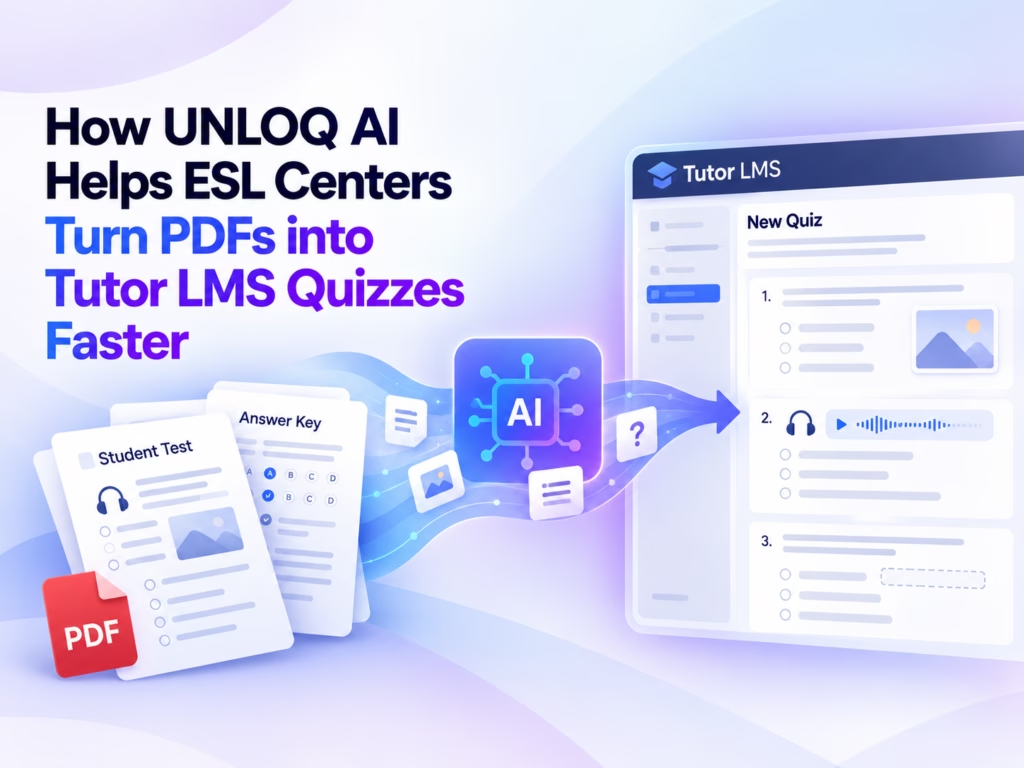
UNLOQ AI helps ESL centers convert existing assessment PDFs and teacher answer keys into structured Tutor LMS quizzes. AI extracts questions, instructions, answer choices, and correct answers, while Python formats import-ready CSV files. Validation flags uncertain items and listening exercises for review, reducing manual data entry, minimizing errors, accelerating course digitization, and freeing staff to focus on teaching.

Creating online quizzes from existing teaching materials sounds simple until someone has to do it manually.
For many ESL centers, assessments already exist as PDFs: placement tests, grammar exercises, reading tasks, listening worksheets, unit tests, and teacher answer keys.
The problem is getting that content into an LMS.
A staff member may need to open the PDF, copy every question, create each answer option, identify the correct answer, choose the right question type, enter instructions, and repeat the process dozens or even hundreds of times.
For a single quiz, that may be manageable.
For an ESL center with many courses, levels, and assessments, it quickly becomes a significant administrative burden.
UNLOQ AI helps automate this process by converting existing PDF assessments and answer keys into structured quiz files that can be imported into Tutor LMS.
The result is less manual data entry, faster course setup, and more time for teachers and staff to focus on teaching rather than LMS administration.
Key Takeaways
- Reuse existing teaching materials: ESL centers can convert assessments they already have in PDF format instead of rebuilding them manually in Tutor LMS.
- Reduce repetitive data entry: Questions, choices, instructions, and correct answers can be extracted and structured automatically.
- Use answer keys for validation: The answer-key PDF provides the authoritative source for correct answers.
- Avoid guessing: If the system cannot reliably match an answer or understand an exercise, it flags the item instead of inventing information.
- Support common ESL exercises: Multiple-choice, true/false, grammar, vocabulary, reading, and other structured exercises can be converted into LMS-ready formats.
- Save staff time: Teachers and administrators spend less time copying content and more time improving courses and supporting students.
The Hidden Cost of Building Online Quizzes Manually
Many language schools already have years of teaching material.
A typical ESL center may have:
- placement tests;
- coursebook exercises;
- grammar worksheets;
- vocabulary tests;
- reading comprehension exercises;
- listening assessments;
- revision tests;
- mid-course and final exams.
Much of this material already exists as PDF files or printable worksheets.
When a center moves these assessments into an LMS such as Tutor LMS, however, the content often has to be recreated manually.
Consider a relatively modest 40-question assessment.
Someone may need to:
- copy the first question from the PDF;
- create a new LMS question;
- choose the question type;
- copy each answer option;
- check the teacher answer key;
- mark the correct answer;
- copy any instructions;
- save the question;
- repeat the process 39 more times.
Then repeat the same process for every assessment in every course.
The work is straightforward, but it is time-consuming and highly repetitive.
It is also easy to make mistakes.
A wrong answer can be marked as correct. An option can be copied incorrectly. A question can be skipped. Instructions can be attached to the wrong exercise.
At scale, manual quiz creation becomes a poor use of teacher and administrative time.
Turning Existing PDFs Into LMS-Ready Quizzes
UNLOQ AI can automate much of this conversion process.
Instead of recreating each assessment manually, the center provides:
- the student assessment PDF; and
- the corresponding teacher answer-key PDF.
The system extracts the content from both documents, identifies the quiz structure, matches answers to questions, and converts the assessment into structured data that can be used to create a Tutor LMS-compatible CSV file.
The CSV can then be imported into Tutor LMS rather than requiring each question to be entered individually.
What previously involved repetitive copying and form filling becomes a much shorter review-and-import process.
How the Technical Process Works
The underlying workflow combines document extraction, AI interpretation, validation, and Python-based data processing.
At a high level, the process looks like this:
Student PDF + Answer Key → Text Extraction → Quiz Structure → Validation → Python Processing → Tutor LMS CSV
The AI identifies elements such as:
- exercise instructions;
- questions;
- answer choices;
- question numbers;
- question types;
- correct answers.
Python then helps transform the structured result into the exact format required for the Tutor LMS import file.
This is important because extracting the content is only part of the problem.
The output also needs to be consistent.
Fields must appear in the correct columns, answer choices must be associated with the correct question, and question types must match the format expected by the LMS.
Automating this formatting removes another layer of repetitive administrative work.
The Answer Key Is the Source of Truth
Accuracy is particularly important when creating assessments.
An AI system should not simply infer which answer looks correct.
UNLOQ AI’s workflow uses the teacher answer key as the authoritative source for auto-graded questions.
The system matches answers using information such as:
- question number;
- exercise order;
- wording;
- answer choices;
- surrounding context.
If the answer cannot be matched reliably, the system does not guess.
Instead, the item is flagged for review.
This fail-closed approach is important for educational content.
Generating a quiz quickly provides little value if the answers are wrong.
The goal is therefore not simply automation. It is reliable automation with human review where needed.
Preserving the Original Assessment
Another important objective is to preserve the teacher’s original material rather than rewriting it unnecessarily.
The workflow is designed to keep:
- question wording;
- answer choices;
- exercise instructions;
- ordering;
- answer-key relationships
as close to the original assessment as practical.
This matters because teaching materials are often carefully designed around a coursebook, curriculum, CEFR level, or lesson objective.
The purpose of the automation is to transfer the material into the LMS, not to redesign the assessment.
What Happens When a Question Cannot Be Converted Reliably?
Real teaching materials are not always perfectly structured.
A PDF may contain:
- complicated page layouts;
- images;
- incomplete extracted text;
- listening tasks;
- dialogues;
- matching exercises;
- unusual question formats.
A reliable automation needs to recognize its limits.
If a question cannot be interpreted confidently, UNLOQ AI’s workflow can flag it as unresolved instead of silently producing a questionable LMS question.
This means staff can review a small number of exceptions rather than manually recreating the entire assessment.
That difference is important.
The aim is not necessarily to remove humans from the process completely.
It is to reduce the amount of work that requires human attention.
Handling Listening Exercises
Listening exercises require slightly different treatment because the answer may depend on an audio file that is not contained in the PDF.
The conversion workflow can identify questions that require audio and flag them accordingly.
The quiz structure, questions, and answer-key information can still be prepared automatically, while the audio itself can be added separately afterward.
This avoids forcing the AI to infer information it cannot reliably determine from the PDF alone.
For an ESL center, it still removes most of the repetitive work involved in building the assessment.
From Hours of Data Entry to Review and Import
The biggest benefit of this type of automation is not the AI technology itself.
It is the change in workflow.
Without automation:
Teacher or administrator → manually creates every LMS question
With automation:
Existing PDFs → automated conversion → staff review → import into Tutor LMS
The employee moves from being a data-entry operator to being a reviewer.
That is usually a much better use of their time.
Instead of spending hours entering information the center already has, staff can focus on checking the result and making any necessary adjustments.
Faster Course Creation
This becomes especially valuable when an ESL center is building or migrating a large number of online courses.
Imagine a program with:
- 10 course levels;
- 12 units per level;
- several quizzes per unit;
- placement and final assessments.
The total number of quiz questions can quickly reach into the thousands.
Manual entry creates a bottleneck.
Even when the educational content is already finished, publishing it online may take weeks simply because someone has to enter everything into the LMS.
Automated conversion allows existing materials to move into the online platform much faster.
This can make it practical for a center to digitize a much larger portion of its curriculum.
Reducing Administrative Costs
Teachers are valuable because of their educational expertise.
Having them spend hours copying multiple-choice questions into WordPress forms is rarely the best use of that expertise.
The same applies to academic coordinators and administrative staff.
Automating repetitive LMS setup can reduce the staff hours required to:
- create quizzes;
- enter answers;
- format question types;
- copy instructions;
- verify answer keys;
- prepare LMS import files.
The benefit is not necessarily reducing headcount.
More often, it means existing employees have more time for work that provides greater value.
Teachers can prepare lessons.
Academic managers can improve the curriculum.
Administrators can support students.
The software handles the repetitive conversion work.
Fewer Manual Errors
Manual data entry introduces another cost: errors.
When someone copies hundreds of questions between systems, mistakes are inevitable.
Common problems include:
- skipped questions;
- duplicated questions;
- incorrect answer options;
- wrong correct-answer settings;
- missing instructions;
- formatting inconsistencies.
Automation provides a more consistent process.
The same validation and formatting rules can be applied to every assessment.
Staff still review the final result, but they are no longer responsible for manually entering every individual field.
Reusing the Materials You Already Have
One of the advantages of this approach is that ESL centers do not need to redesign their entire curriculum around new AI-generated content.
They can continue using existing teaching materials.
A center may already have hundreds of carefully prepared PDFs developed over years.
Those materials represent significant intellectual and financial investment.
Rather than discarding them or manually rebuilding them for an LMS, automation can help convert them into a format suitable for online delivery.
This makes digital transformation less disruptive.
The technology adapts to the center’s existing content instead of forcing the center to rebuild everything from scratch.
A Practical Example
Consider an ESL center moving an existing grammar assessment into Tutor LMS.
The center already has:
StudentQuestionSheet.pdf
containing 50 questions across several exercises.
It also has:
TeacherAnswerKey.pdf
containing the correct answers.
Traditionally, someone would manually create all 50 questions inside the LMS.
With an automated workflow, the two PDFs are uploaded instead.
The system extracts the content, identifies the exercises and questions, matches the correct answers from the teacher key, validates the resulting quiz, and generates an importable Tutor LMS CSV.
If 47 questions can be converted confidently and three require manual review, staff only need to inspect those exceptions.
That is a fundamentally different workload from manually creating all 50 questions.
Automation Beyond a Single Quiz
The same principle can be applied across an entire course library.
Once the workflow has been designed around a center’s assessment format, it can be reused for additional PDFs.
That makes the benefit cumulative.
The first converted assessment saves time.
The fiftieth assessment saves far more.
For centers with large libraries of existing materials, automation can therefore significantly accelerate the process of moving courses online.
How UNLOQ AI Approaches Education Automation
At UNLOQ AI, we focus on automating repetitive workflows rather than simply adding AI for its own sake.
For an ESL center, that can mean connecting:
Existing teaching material → AI extraction → validation → Python processing → LMS-ready content
The exact implementation can be adapted to the center’s documents, LMS structure, and assessment requirements.
Importantly, the workflow can also include safeguards.
If the source material does not contain enough information to create a reliable question, the system can stop or flag the item instead of inventing an answer.
This allows automation to handle the repetitive work while keeping teachers in control of the educational content.
The Bigger Benefit: More Time for Teaching
The most important outcome is not faster CSV generation.
It is time.
Every hour spent copying questions into an LMS is an hour that could have been spent on:
- lesson preparation;
- curriculum development;
- student feedback;
- teacher training;
- improving course materials;
- supporting students.
AI automation is most useful when it removes this kind of repetitive administrative work.
For ESL centers, converting existing assessments into LMS-ready quizzes is a good example of a task where technology can save significant time without changing the underlying teaching methodology.
The center keeps its existing curriculum.
The teachers keep control over the content.
The software handles much of the repetitive conversion work.
Conclusion
Many ESL centers already possess the content they need for online learning.
The challenge is getting that content into the LMS efficiently.
Manually recreating hundreds or thousands of questions from PDFs is slow, repetitive, and prone to error.
UNLOQ AI can automate much of this process by converting student assessment PDFs and teacher answer keys into structured Tutor LMS import files.
AI handles the interpretation of the source material, Python handles the structured transformation, and validation rules help prevent unreliable questions from being imported.
Staff remain responsible for reviewing the educational content, but they no longer need to enter every question by hand.
For ESL centers with substantial libraries of existing assessments, this kind of workflow automation can reduce administrative work, speed up course creation, and free teachers and staff to focus on what matters most: teaching and supporting students.