
Introducing IELTS Studio: A Dedicated Platform for Digital IELTS Preparation
IELTS Studio is a dedicated digital platform for IELTS preparation centers, helping students practice computer-based Reading, Listening, Writing, and Speaking assessments. Teachers can create and manage tests, automate marking, review submissions, and use optional AI-assisted feedback. By streamlining mock tests and administrative workflows, the platform creates more practice opportunities while freeing teachers to focus on meaningful support.

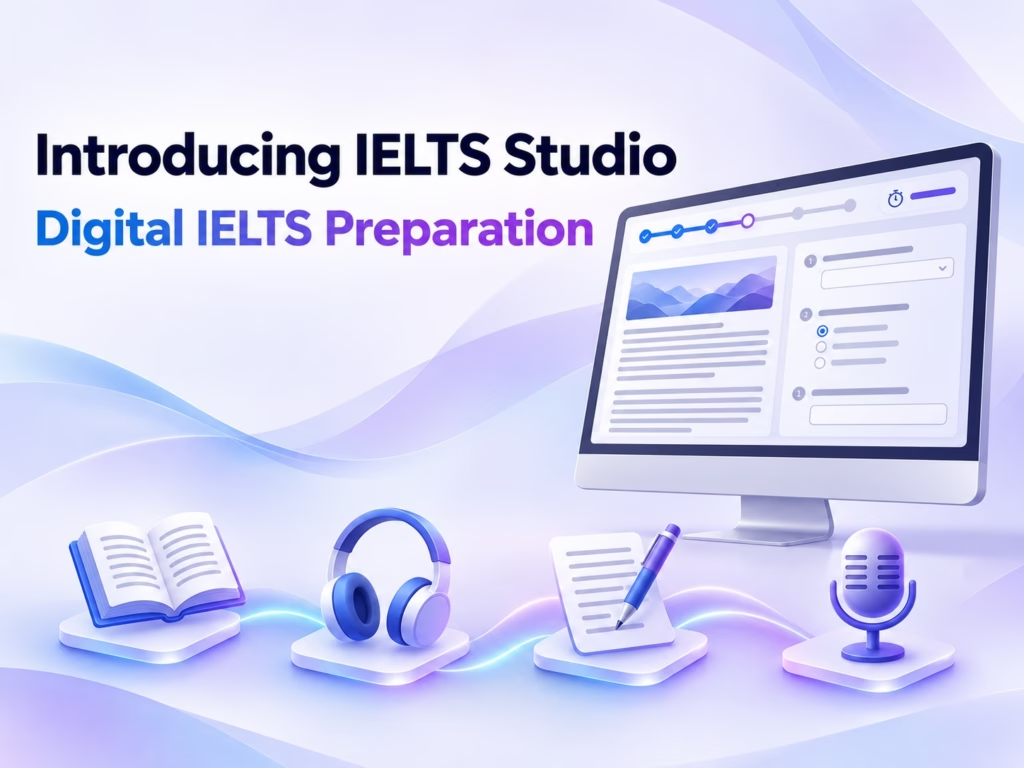
Preparing students for IELTS involves much more than teaching English. Students also need to become familiar with the exam format, develop effective time-management strategies, complete practice tests, and understand where they need to improve.
For IELTS preparation centers, delivering this experience consistently can require considerable time and resources. Teachers need to prepare assessments, administrators need to organize mock tests, and students need access to suitable practice materials.
General-purpose learning management systems can handle many of these tasks, but they are not necessarily designed around the specific requirements of IELTS.
IELTS Studio is a dedicated digital platform designed to bring IELTS preparation and mock testing into a more focused online environment, helping education centers deliver a better learning experience while reducing administrative work.
Key Takeaways
- Purpose-built for IELTS: A dedicated platform designed around IELTS preparation rather than generic online quizzes.
- Computer-based test preparation: Students can develop familiarity with digital assessments before sitting the actual exam.
- Reduced administrative workload: Digital assessment workflows can reduce repetitive test preparation, marking, and result handling.
- More opportunities for practice: Students can work on their skills beyond scheduled classroom sessions.
- Better use of teaching resources: Teachers can spend less time on routine assessment administration and more time helping students improve.
- Scalable digital learning: Education centers can extend their IELTS preparation services without proportionally increasing administrative resources.
How IELTS Studio Works
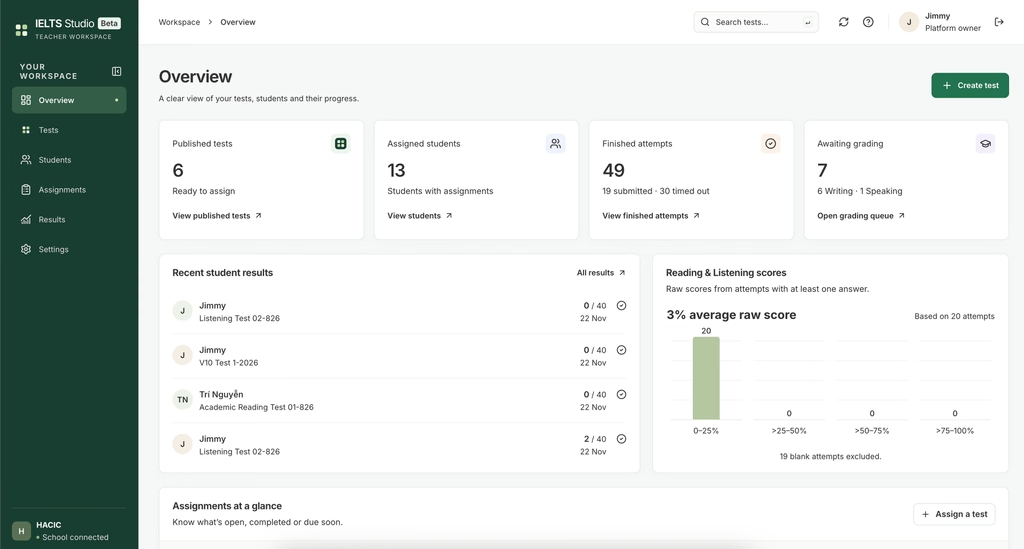
Teachers create and manage tests in a central dashboard. Students sign in through their education center’s connected WordPress site and take the tests assigned to them.
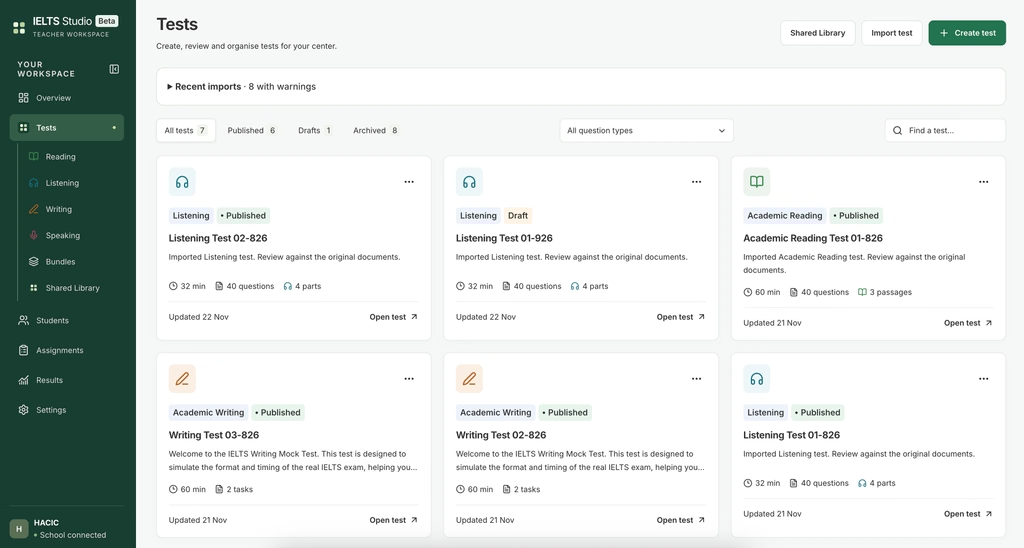
Reading and Listening tests can be imported from documents and reviewed before publication. Teachers can create Writing tasks and Speaking practice, assign individual tests or combine published tests into a full mock, and review submissions in the dashboard.
Assignments can be given to individual students or classes, with availability dates and attempt limits. Students can resume attempts and view their results when available.
The Challenges of Traditional IELTS Preparation
Many IELTS preparation centers still rely on a combination of printed materials, PDF documents, spreadsheets, general-purpose learning platforms, and manually graded assessments.
Although these methods work, they create additional work for teachers and administrators. Organizing a mock test may involve preparing question papers, distributing answer sheets, managing audio files, monitoring exam timing, collecting submissions, and recording results.
When a center runs multiple IELTS courses across different levels or locations, these tasks become increasingly difficult to manage efficiently.
Students also face limitations. Completing a printed practice test is useful for developing language skills, but it does not necessarily prepare them for interacting with a computer-based examination interface.
IELTS Studio is designed around these practical challenges.
Why IELTS Needs a Dedicated Digital Platform
General-purpose learning management systems are designed to accommodate many different subjects and assessment formats. While this flexibility is valuable, IELTS has a distinctive structure that does not always fit neatly into conventional online quizzes.
IELTS assessments involve different skills, question formats, reading passages, listening recordings, writing tasks, and time constraints.
A dedicated platform can be designed around these requirements from the beginning rather than adapting a generic quiz system to accommodate them.
This creates an opportunity to deliver a more coherent preparation experience, where the technology supports the assessment format instead of placing unnecessary restrictions on it.
Preparing Students for Computer-Based IELTS
Knowing English and knowing how to navigate an examination are two different skills.
A student may have strong reading comprehension but struggle to manage time effectively when working through a long passage on a computer screen. Another may be comfortable writing essays by hand but less confident typing under examination conditions.
Regular digital practice helps students become more comfortable with the mechanics of computer-based testing, including:
- reading extended passages on screen;
- navigating between questions;
- entering and reviewing answers;
- working within time limits;
- completing assessments using a keyboard and mouse;
- maintaining concentration during longer examinations.
By making digital testing a regular part of IELTS preparation, students can spend less mental energy adapting to the test environment and more energy demonstrating their English language abilities.
Reducing the Workload of Running IELTS Mock Tests
Mock tests are an important part of IELTS preparation, but they can also be resource-intensive.
Consider an education center conducting mock tests for several classes every month. Even when the examination materials are already available, staff still need to organize the test sessions, manage submissions, check answers, and communicate results.
Moving these activities into a dedicated digital platform creates opportunities to automate many of the repetitive tasks associated with assessment delivery.
For question types with predefined correct answers, automated marking can reduce the time teachers spend checking individual responses. Digital submissions also reduce the need to handle printed answer sheets and manually transfer information between systems.
The objective is not to remove teachers from the assessment process. It is to reduce the amount of routine work that does not require their professional judgment.
More Practice Without More Classroom Hours
IELTS preparation requires regular practice, but classroom time is limited.
Teachers need to balance language development, examination strategies, individual feedback, and assessment activities within a fixed number of lessons.
A dedicated online preparation platform allows students to continue practicing outside scheduled classes. This makes it possible to use classroom time more effectively.
Instead of spending an entire lesson completing an assessment that students could undertake independently, teachers can concentrate on explaining difficult concepts, reviewing common mistakes, and developing examination strategies.
For students, this creates a more flexible learning experience. For education centers, it helps increase the educational value of existing teaching hours without necessarily increasing the number of scheduled lessons.
Making Assessment Results More Useful
The value of a mock test extends beyond the final score.
A student needs to understand which areas are causing difficulties and what to focus on before the next assessment.
For example, a student who consistently struggles with matching headings in IELTS Reading may need a different preparation strategy from someone who understands the passages but repeatedly runs out of time.
Digital assessment data provides a foundation for identifying these patterns more systematically.
Over time, information collected through digital practice can help teachers make more informed decisions about lesson planning, revision activities, and individual student support.
Rather than treating each mock test as an isolated event, education centers can use assessments as part of an ongoing learning process.
The Role of AI in IELTS Preparation
Reading and Listening responses can be marked automatically against a reviewed answer key. Writing and Speaking require a more nuanced evaluation of language use.
IELTS Studio supports manual Writing grading and optional AI draft feedback. Teachers review the work and release the grade before students can see it.
For Speaking, students record a three-part practice attempt in their browser. Teachers can listen to the recordings, and where the required speech and grading services are configured, request a private AI assessment draft based on the IELTS criteria.
These tools support teacher judgment and provide additional information for feedback. They are not official IELTS examination results.
Reducing Dependence on Multiple Learning Tools
Many education centers use separate tools for course content, assessments, student submissions, feedback, and administrative records.
Each additional tool introduces another interface to learn, another system to maintain, and potentially another subscription to manage.
A dedicated IELTS preparation platform offers an opportunity to consolidate related learning and assessment activities into a more consistent environment.
For students, this means less time navigating between unrelated applications. For teachers and administrators, it can mean fewer fragmented workflows and less repetitive handling of information.
The technology should make IELTS preparation easier to deliver, not introduce another layer of administrative complexity.
Helping IELTS Centers Scale More Efficiently
As an education center grows, its assessment workload typically grows with it.
More students mean more test submissions, more marking, more result management, and more individual requests for feedback.
Without automation, expanding an IELTS program may require additional administrative and teaching resources simply to maintain the same level of service.
A digital preparation platform can help reduce this dependency by making practice materials and assessment workflows reusable across larger student groups.
This is particularly valuable for education centers operating multiple branches or offering a combination of classroom-based and online courses.
Instead of rebuilding the same assessment processes at each location, centers can work toward a more standardized digital preparation experience.
Better Use of Teacher Expertise
Qualified IELTS teachers bring expertise that cannot be reduced to marking answer sheets or entering scores into spreadsheets.
Their greatest value lies in understanding why students struggle, explaining complex language concepts, developing effective learning strategies, and providing meaningful individual feedback.
Every hour spent on repetitive assessment administration is an hour that could potentially be used for these higher-value activities.
By automating suitable parts of the preparation and assessment process, IELTS Studio aims to help education centers make better use of their existing teaching resources.
The platform supports teachers rather than attempting to replace them.
UNLOQ AI’s Approach to Educational Technology
At UNLOQ AI, we believe educational technology should address practical problems rather than introduce artificial intelligence simply for its own sake.
Our approach combines purpose-built software, workflow automation, and AI-assisted functionality where it provides meaningful benefits.
IELTS Studio reflects this philosophy by focusing on the specific challenges associated with digital IELTS preparation and assessment.
Rather than expecting teachers and administrators to adapt their workflows around generic software, the objective is to develop technology around the way IELTS education is actually delivered.
This means prioritizing the student experience, reducing unnecessary administrative work, and keeping educational professionals in control of the learning process.
Who Is IELTS Studio Designed For?
IELTS Studio is particularly relevant to education providers looking to strengthen or expand their digital IELTS preparation services, including:
- IELTS preparation centers;
- private English language schools;
- ESL centers offering IELTS courses;
- independent IELTS teachers;
- education providers delivering blended or online learning;
- organizations conducting regular IELTS mock tests.
It is especially relevant for centers that want a dedicated IELTS preparation environment rather than relying entirely on printed assessments or general-purpose learning management systems.
Conclusion
Effective IELTS preparation requires quality teaching, consistent practice, realistic assessments, and meaningful feedback.
However, delivering these activities at scale does not have to involve a proportional increase in administrative work.
IELTS Studio is designed to help education centers make digital IELTS preparation more accessible, efficient, and consistent.
By combining a dedicated preparation environment with assessment automation and opportunities for AI-assisted feedback, the platform aims to provide students with more opportunities to practice while allowing teachers to focus on the areas where their expertise matters most.
For UNLOQ AI, the objective is straightforward: use technology to reduce repetitive work, improve the learning experience, and help education providers deliver better services with their existing resources.