
Why Vietnamese Language Support Matters for RAG Chatbots
Deploying AI chatbots in Vietnam requires models that understand local nuances rather than relying on English-first systems. Retrieval-Augmented Generation depends heavily on language accuracy to retrieve relevant business data. Using Vietnamese-optimized embeddings and language models ensures accurate search results, natural customer interactions, and reliable automated support for local businesses.

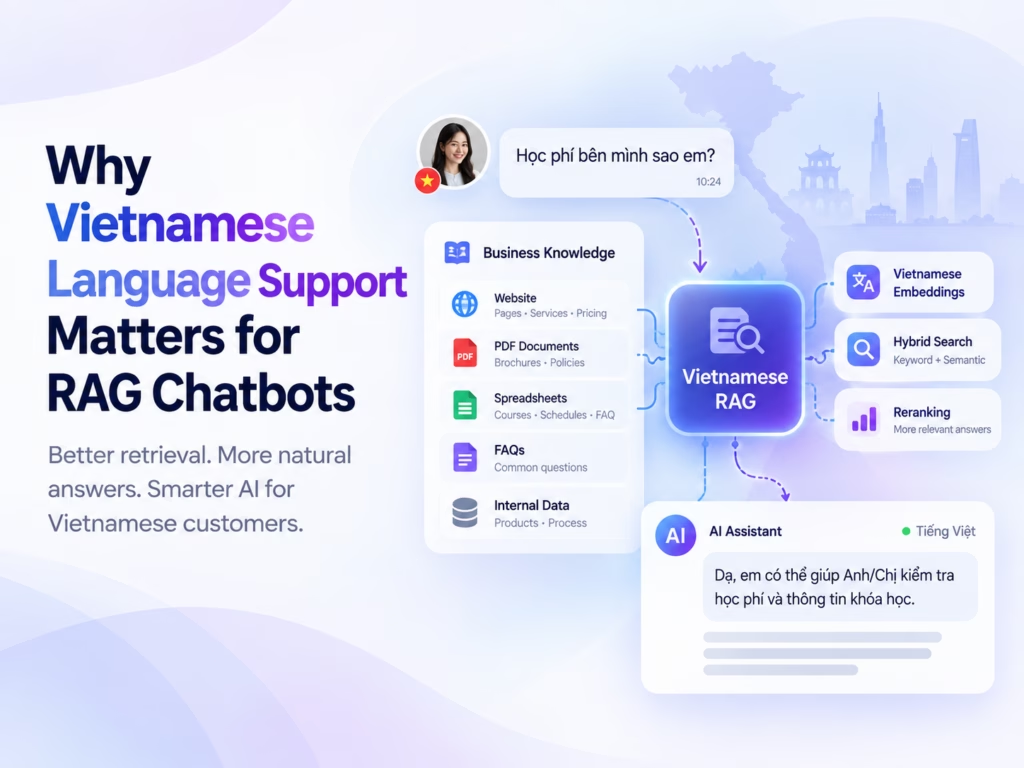
In the race to deploy AI chatbots, many businesses are discovering a critical limitation: a model that performs well in English may perform much worse when customers interact with it in Vietnamese or another local language.
Retrieval-Augmented Generation (RAG) helps businesses build chatbots that answer questions using their own documents, manuals, FAQs, and internal knowledge. But the quality of a RAG system depends heavily on how well its models understand the language used by customers and in the knowledge base.
For businesses in Vietnam, this means choosing AI models that handle Vietnamese accurately rather than assuming strong English performance will automatically translate into strong local-language performance.
Key Takeaways:
- RAG depends on language understanding: A chatbot must understand the user’s question well enough to retrieve the correct information from the knowledge base.
- Embeddings matter: The embedding model used for semantic search should perform strongly in Vietnamese or whichever local language the business uses.
- Translation is not always the best solution: Translating every query into English adds complexity and can lose meaning, terminology, or context.
- Local context matters: Good language models should understand common expressions, terminology, levels of formality, and the way people actually communicate locally.
- Especially important for SMBs: Businesses serving primarily Vietnamese-speaking customers need AI systems optimized for those customers, not systems designed primarily around English.
How RAG Makes AI Chatbots More Reliable
Early large language model chatbots could generate remarkably fluent answers, but they also had a tendency to “hallucinate”—producing information that sounded plausible but was incorrect.
Retrieval-Augmented Generation (RAG) addresses this problem by connecting the chatbot to a controlled knowledge base.
When a user asks a question, the system first searches relevant company information such as product documentation, FAQs, policies, service information, or support materials. It then passes the most relevant information to the language model so the answer can be grounded in the company’s actual data.
For small and medium-sized businesses, this makes it possible to build useful AI assistants without retraining a large model from scratch. Updating the chatbot’s knowledge can be as simple as updating the underlying documents or website content.
However, the entire process depends on retrieval accuracy. If the system fails to understand the question or retrieve the correct information, even an advanced LLM will struggle to provide a useful answer.
That is where local-language support becomes important.
Why English-First AI Can Struggle With Vietnamese
Many AI tools and embedding models have historically been developed with a strong emphasis on English. While modern models are increasingly capable across languages, performance can still vary significantly.
Vietnamese presents its own linguistic challenges, including compound words, tones, regional vocabulary, informal expressions, industry terminology, and frequent mixing of Vietnamese and English.
Consider a customer asking:
“Tôi muốn đổi lịch học thì phải làm sao?”
A RAG system needs to understand that the user is asking about changing or rescheduling a class and retrieve the relevant policy or procedure—even if the wording in the knowledge base is different.
A weak embedding model may rely too heavily on exact wording or fail to capture the semantic relationship between the question and the relevant document.
The result can be irrelevant search results or no useful information at all.
Translation can sometimes help, but translating every query into English before retrieval introduces additional processing and potential errors. Product names, local terminology, names, abbreviations, and subtle distinctions can easily be distorted.
Where possible, it is better for the system to understand the original Vietnamese query directly.
The Importance of Local-Language Embeddings
Embeddings are one of the most important components of a RAG system.
An embedding model converts text into numerical representations called vectors. These vectors allow the system to compare the meaning of a user’s question with the meaning of information stored in the knowledge base.
For a Vietnamese RAG chatbot, the embedding model should have strong Vietnamese semantic understanding.
For example, a customer might ask:
“Sản phẩm này được bảo hành bao lâu?”
The relevant document might contain a heading such as:
“Chính sách và thời hạn bảo hành.”
A good embedding model understands that these phrases are closely related even though they do not use exactly the same words.
Strong local-language embeddings therefore improve the most important step in RAG: finding the right information before the LLM generates its answer.
Modern multilingual embedding models can also be useful when a company has content in both Vietnamese and English. They can place semantically related information from different languages into the same vector space, allowing a Vietnamese question to retrieve relevant English content—or the reverse—when necessary.
The goal, however, is not multilingualism for its own sake. The goal is reliable retrieval in the languages the business and its customers actually use.
Choosing an LLM That Handles Vietnamese Well
Retrieval is only the first half of the process.
Once the correct information has been found, the LLM must turn that information into a clear, accurate, and natural response.
A model used for Vietnamese customer service should be able to handle Vietnamese grammar, vocabulary, tone, and levels of formality naturally. This is particularly important because Vietnamese business communication often depends on appropriate forms of address such as Anh, Chị, Em, Cô, or Chú.
The chatbot should also understand common Vietnamese ways of asking questions rather than expecting perfectly structured or formal input.
For example:
“Học phí bên mình sao em?”
and
“Cho chị hỏi khóa này bao nhiêu tiền?”
may be asking essentially the same thing.
A capable model should understand both naturally and respond using the appropriate tone.
For customer-facing applications, this makes the difference between an AI system that technically supports Vietnamese and one that actually feels comfortable for Vietnamese customers to use.
Unloq AI’s Approach to Vietnamese RAG Chatbots
At Unloq AI, we build RAG chatbots around the language customers actually use.
For businesses in Vietnam, that usually means designing the system to work naturally with Vietnamese from the beginning rather than treating Vietnamese as an additional translation layer.
We use embedding models selected for strong Vietnamese semantic search and pair them with LLMs that can generate natural Vietnamese responses.
The client’s existing knowledge base—website content, documents, spreadsheets, policies, product information, and FAQs—can remain in Vietnamese and be indexed directly for retrieval.
This allows the chatbot to understand questions such as:
“Khóa IELTS này dành cho trình độ nào?”
“Có học thử trước không?”
“Đổi lịch học như thế nào?”
or
“Sản phẩm này còn hàng không?”
and retrieve the corresponding information from the business’s own data.
The same architecture can also support English when required, particularly for companies serving international customers or maintaining documentation in both languages.
The objective is not to make every chatbot speak dozens of languages. It is to make sure the chatbot works exceptionally well in the languages that matter to the business.
Why This Matters for Vietnamese Businesses
For many Vietnamese SMBs, English is not the primary language of customer interaction.
Customers communicate through websites, Facebook Messenger, Zalo, WhatsApp, and other channels using natural Vietnamese. They may use abbreviations, informal wording, regional expressions, or a mixture of Vietnamese and English terminology.
If an AI chatbot cannot understand those conversations accurately, its usefulness drops quickly.
A well-designed Vietnamese RAG chatbot can help businesses:
- answer customer questions around the clock;
- provide consistent information from company-approved sources;
- reduce repetitive support work;
- capture and qualify leads;
- guide customers toward products or services;
- and escalate conversations to staff when human assistance is needed.
The underlying technology matters because better language understanding leads directly to better retrieval—and better retrieval leads to more accurate answers.
Conclusion
An effective RAG chatbot does not need to support every language in the world. It needs to perform well in the languages its customers actually use.
For businesses in Vietnam, that means ensuring both the retrieval system and the language model are capable of handling Vietnamese accurately and naturally.
Strong Vietnamese embeddings improve the system’s ability to find relevant information. A capable LLM then turns that information into clear, contextually appropriate responses.
Rather than forcing every interaction through English, businesses can build AI systems around their existing local-language content and the way their customers already communicate.
For Vietnamese SMBs, that makes local-language RAG not simply a localization feature, but a practical requirement for building useful AI customer service.
FAQs
Q: Can’t I just translate Vietnamese queries into English before searching?
A: You can, but it adds another layer where errors can occur. Translation may change terminology, names, product references, or subtle meaning. When suitable Vietnamese-capable models are available, processing the original query directly is usually cleaner and more reliable.
Q: Does my entire knowledge base need to be in Vietnamese?
A: No. A well-designed RAG system can work with Vietnamese, English, or a mixture of both. Modern embedding models can often match related content across languages when necessary.
Q: Are Vietnamese-capable AI models more expensive?
A: Not necessarily. Many current embedding models and LLMs already provide strong Vietnamese support at competitive prices. Model selection should be based on retrieval quality, response quality, latency, and cost rather than language support alone.
Q: What if customers use informal Vietnamese or mix Vietnamese with English?
A: Strong modern models can usually handle informal language, abbreviations, and code-switching. This is particularly important for customer service, where people rarely write in perfectly formal Vietnamese.
Q: Does the chatbot need a model trained only on Vietnamese?
A: No. A strong multilingual model can perform very well in Vietnamese. What matters is measured performance on Vietnamese queries and your specific business data, not whether the model is exclusively Vietnamese.
Q: Can the chatbot still answer customers in English?
A: Yes. Supporting Vietnamese as a primary local language does not prevent the chatbot from supporting English as well. The system can detect or follow the user’s language and respond accordingly.